

Shatavari: The Sacred River of Nourishment Within
There is a hidden river flowing inside your body a current of nourishment that carries life to every tissue, every organ, every cell. Ayurveda calls this flow Rasa, the vital essence formed from digestion and distributed throughout the body. When this river moves clearly and is well-nourished, vitality shines. When it becomes overheated, depleted, or stagnant, imbalance begins. One of the greatest herbs ever described by the sages to protect and replenish this inner river is Shatavari a cooling, deeply restorative tonic that supports the body’s natural intelligence and long-term resilience.


Shatavari Powder
$12.99
$12.99
Sale price
Shipping calculated at checkout.
In stock
Description
Shatavari is a traditional Ayurvedic herb valued for its role in supporting overall wellness. Known as a natural rejuvenative, it has been used for centuries to help maintain balance across multiple body systems.
Our Shatavari Powder is carefully sourced and processed to preserve its natural potency, making it an easy addition to your daily routine.


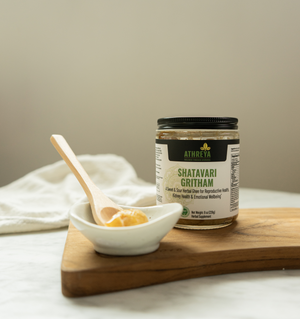
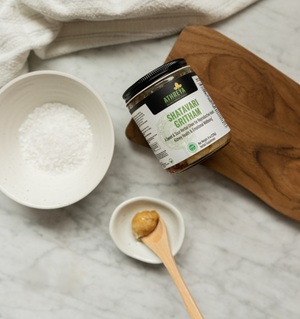
Shatavari Gritham
$41.99
$41.99
Sale price
Shipping calculated at checkout.
In stock
Description
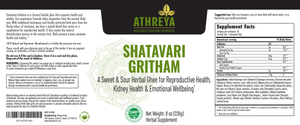
Shatavari Ghritam is a classical Ayurvedic formulation prepared by infusing Shatavari and complementary herbs in pure ghee. Traditionally valued for its nourishing, cooling, and rejuvenating properties, it is widely used to support women’s wellness, urinary health, and overall vitality.
Shatavari Ghritam is traditionally used to support reproductive health by helping maintain balance in reproductive tissues and supporting overall feminine wellness. It contributes to internal nourishment and vitality as part of a balanced lifestyle.
This formulation is also appreciated for supporting urinary tract health by helping maintain comfort and supporting natural cleansing processes within the urogenital system.
In addition, Shatavari Ghritam supports digestive balance by helping soothe internal tissues and promoting digestive comfort. The ghee-based preparation enhances absorption and supports efficient delivery of nutrients.
Shatavari Ghritam is further valued for supporting energy levels and emotional balance, contributing to overall well-being and daily vitality.
Prepared using traditional Ayurvedic methods, our Shatavari Ghritam ensures purity, potency, and optimal bioavailability.
100 Years Jay Blog - Past Articles
-

What Are the Six Tastes in Ayurveda? Shadrasa Explained by Vaidya Jay
The six tastes in Ayurveda are sweet, sour, salty, pungent, bitter and astringent. Vaidya Jay calls the concept Shadrasa. In this food class he lays a table of vegetables, names...
-

Which Oil Does Ayurveda Use for Hair? Neelibringadhi Thailam
The Daily Essentials · Chapter Four Which Oil Does Ayurveda Use for Hair? Neelibringadhi Thailam The celebrated oil, a scalp massage, and the part of the shelf you can see....
-

What Is Ashwagandha Lehyam? The Ayurvedic Ashwagandha Jam
The Daily Essentials · Chapter Three What Is Ashwagandha Lehyam? The Ayurvedic Ashwagandha Jam A daily spoonful of the classical jam, and the doctor's rule for when to take it....


Localization options
 United States
|
USD
$
United States
|
USD
$
You are currently shipping to United States and your order will be billed in USD $.
-
 Afghanistan
USD
$
Afghanistan
USD
$
-
 Åland Islands
USD
$
Åland Islands
USD
$
-
 Albania
USD
$
Albania
USD
$
-
 Algeria
USD
$
Algeria
USD
$
-
 Andorra
USD
$
Andorra
USD
$
-
 Angola
USD
$
Angola
USD
$
-
 Anguilla
USD
$
Anguilla
USD
$
-
 Antigua & Barbuda
USD
$
Antigua & Barbuda
USD
$
-
 Argentina
USD
$
Argentina
USD
$
-
 Armenia
USD
$
Armenia
USD
$
-
 Aruba
USD
$
Aruba
USD
$
-
 Ascension Island
USD
$
Ascension Island
USD
$
-
 Australia
USD
$
Australia
USD
$
-
 Austria
USD
$
Austria
USD
$
-
 Azerbaijan
USD
$
Azerbaijan
USD
$
-
 Bahamas
USD
$
Bahamas
USD
$
-
 Bahrain
USD
$
Bahrain
USD
$
-
 Bangladesh
USD
$
Bangladesh
USD
$
-
 Barbados
USD
$
Barbados
USD
$
-
 Belarus
USD
$
Belarus
USD
$
-
 Belgium
USD
$
Belgium
USD
$
-
 Belize
USD
$
Belize
USD
$
-
 Benin
USD
$
Benin
USD
$
-
 Bermuda
USD
$
Bermuda
USD
$
-
 Bhutan
USD
$
Bhutan
USD
$
-
 Bolivia
USD
$
Bolivia
USD
$
-
 Bosnia & Herzegovina
USD
$
Bosnia & Herzegovina
USD
$
-
 Botswana
USD
$
Botswana
USD
$
-
 Brazil
USD
$
Brazil
USD
$
-
 British Indian Ocean Territory
USD
$
British Indian Ocean Territory
USD
$
-
 British Virgin Islands
USD
$
British Virgin Islands
USD
$
-
 Brunei
USD
$
Brunei
USD
$
-
 Bulgaria
USD
$
Bulgaria
USD
$
-
 Burkina Faso
USD
$
Burkina Faso
USD
$
-
 Burundi
USD
$
Burundi
USD
$
-
 Cambodia
USD
$
Cambodia
USD
$
-
 Cameroon
USD
$
Cameroon
USD
$
-
 Canada
USD
$
Canada
USD
$
-
 Cape Verde
USD
$
Cape Verde
USD
$
-
 Caribbean Netherlands
USD
$
Caribbean Netherlands
USD
$
-
 Cayman Islands
USD
$
Cayman Islands
USD
$
-
 Central African Republic
USD
$
Central African Republic
USD
$
-
 Chad
USD
$
Chad
USD
$
-
 Chile
USD
$
Chile
USD
$
-
 China
USD
$
China
USD
$
-
 Christmas Island
USD
$
Christmas Island
USD
$
-
 Cocos (Keeling) Islands
USD
$
Cocos (Keeling) Islands
USD
$
-
 Colombia
USD
$
Colombia
USD
$
-
 Comoros
USD
$
Comoros
USD
$
-
 Congo - Brazzaville
USD
$
Congo - Brazzaville
USD
$
-
 Congo - Kinshasa
USD
$
Congo - Kinshasa
USD
$
-
 Cook Islands
USD
$
Cook Islands
USD
$
-
 Costa Rica
USD
$
Costa Rica
USD
$
-
 Côte d’Ivoire
USD
$
Côte d’Ivoire
USD
$
-
 Croatia
USD
$
Croatia
USD
$
-
 Curaçao
USD
$
Curaçao
USD
$
-
 Cyprus
USD
$
Cyprus
USD
$
-
 Czechia
USD
$
Czechia
USD
$
-
 Denmark
USD
$
Denmark
USD
$
-
 Djibouti
USD
$
Djibouti
USD
$
-
 Dominica
USD
$
Dominica
USD
$
-
 Dominican Republic
USD
$
Dominican Republic
USD
$
-
 Ecuador
USD
$
Ecuador
USD
$
-
 Egypt
USD
$
Egypt
USD
$
-
 El Salvador
USD
$
El Salvador
USD
$
-
 Equatorial Guinea
USD
$
Equatorial Guinea
USD
$
-
 Eritrea
USD
$
Eritrea
USD
$
-
 Estonia
USD
$
Estonia
USD
$
-
 Eswatini
USD
$
Eswatini
USD
$
-
 Ethiopia
USD
$
Ethiopia
USD
$
-
 Falkland Islands
USD
$
Falkland Islands
USD
$
-
 Faroe Islands
USD
$
Faroe Islands
USD
$
-
 Fiji
USD
$
Fiji
USD
$
-
 Finland
USD
$
Finland
USD
$
-
 France
USD
$
France
USD
$
-
 French Guiana
USD
$
French Guiana
USD
$
-
 French Polynesia
USD
$
French Polynesia
USD
$
-
 French Southern Territories
USD
$
French Southern Territories
USD
$
-
 Gabon
USD
$
Gabon
USD
$
-
 Gambia
USD
$
Gambia
USD
$
-
 Georgia
USD
$
Georgia
USD
$
-
 Germany
USD
$
Germany
USD
$
-
 Ghana
USD
$
Ghana
USD
$
-
 Gibraltar
USD
$
Gibraltar
USD
$
-
 Greece
USD
$
Greece
USD
$
-
 Greenland
USD
$
Greenland
USD
$
-
 Grenada
USD
$
Grenada
USD
$
-
 Guadeloupe
USD
$
Guadeloupe
USD
$
-
 Guatemala
USD
$
Guatemala
USD
$
-
 Guernsey
USD
$
Guernsey
USD
$
-
 Guinea
USD
$
Guinea
USD
$
-
 Guinea-Bissau
USD
$
Guinea-Bissau
USD
$
-
 Guyana
USD
$
Guyana
USD
$
-
 Haiti
USD
$
Haiti
USD
$
-
 Honduras
USD
$
Honduras
USD
$
-
 Hong Kong SAR
USD
$
Hong Kong SAR
USD
$
-
 Hungary
USD
$
Hungary
USD
$
-
 Iceland
USD
$
Iceland
USD
$
-
 India
USD
$
India
USD
$
-
 Indonesia
USD
$
Indonesia
USD
$
-
 Iraq
USD
$
Iraq
USD
$
-
 Ireland
USD
$
Ireland
USD
$
-
 Isle of Man
USD
$
Isle of Man
USD
$
-
 Israel
USD
$
Israel
USD
$
-
 Italy
USD
$
Italy
USD
$
-
 Jamaica
USD
$
Jamaica
USD
$
-
 Japan
USD
$
Japan
USD
$
-
 Jersey
USD
$
Jersey
USD
$
-
 Jordan
USD
$
Jordan
USD
$
-
 Kazakhstan
USD
$
Kazakhstan
USD
$
-
 Kenya
USD
$
Kenya
USD
$
-
 Kiribati
USD
$
Kiribati
USD
$
-
 Kosovo
USD
$
Kosovo
USD
$
-
 Kuwait
USD
$
Kuwait
USD
$
-
 Kyrgyzstan
USD
$
Kyrgyzstan
USD
$
-
 Laos
USD
$
Laos
USD
$
-
 Latvia
USD
$
Latvia
USD
$
-
 Lebanon
USD
$
Lebanon
USD
$
-
 Lesotho
USD
$
Lesotho
USD
$
-
 Liberia
USD
$
Liberia
USD
$
-
 Libya
USD
$
Libya
USD
$
-
 Liechtenstein
USD
$
Liechtenstein
USD
$
-
 Lithuania
USD
$
Lithuania
USD
$
-
 Luxembourg
USD
$
Luxembourg
USD
$
-
 Macao SAR
USD
$
Macao SAR
USD
$
-
 Madagascar
USD
$
Madagascar
USD
$
-
 Malawi
USD
$
Malawi
USD
$
-
 Malaysia
USD
$
Malaysia
USD
$
-
 Maldives
USD
$
Maldives
USD
$
-
 Mali
USD
$
Mali
USD
$
-
 Malta
USD
$
Malta
USD
$
-
 Martinique
USD
$
Martinique
USD
$
-
 Mauritania
USD
$
Mauritania
USD
$
-
 Mauritius
USD
$
Mauritius
USD
$
-
 Mayotte
USD
$
Mayotte
USD
$
-
 Mexico
USD
$
Mexico
USD
$
-
 Moldova
USD
$
Moldova
USD
$
-
 Monaco
USD
$
Monaco
USD
$
-
 Mongolia
USD
$
Mongolia
USD
$
-
 Montenegro
USD
$
Montenegro
USD
$
-
 Montserrat
USD
$
Montserrat
USD
$
-
 Morocco
USD
$
Morocco
USD
$
-
 Mozambique
USD
$
Mozambique
USD
$
-
 Myanmar (Burma)
USD
$
Myanmar (Burma)
USD
$
-
 Namibia
USD
$
Namibia
USD
$
-
 Nauru
USD
$
Nauru
USD
$
-
 Nepal
USD
$
Nepal
USD
$
-
 Netherlands
USD
$
Netherlands
USD
$
-
 New Caledonia
USD
$
New Caledonia
USD
$
-
 New Zealand
USD
$
New Zealand
USD
$
-
 Nicaragua
USD
$
Nicaragua
USD
$
-
 Niger
USD
$
Niger
USD
$
-
 Nigeria
USD
$
Nigeria
USD
$
-
 Niue
USD
$
Niue
USD
$
-
 Norfolk Island
USD
$
Norfolk Island
USD
$
-
 North Macedonia
USD
$
North Macedonia
USD
$
-
 Norway
USD
$
Norway
USD
$
-
 Oman
USD
$
Oman
USD
$
-
 Pakistan
USD
$
Pakistan
USD
$
-
 Palestinian Territories
USD
$
Palestinian Territories
USD
$
-
 Panama
USD
$
Panama
USD
$
-
 Papua New Guinea
USD
$
Papua New Guinea
USD
$
-
 Paraguay
USD
$
Paraguay
USD
$
-
 Peru
USD
$
Peru
USD
$
-
 Philippines
USD
$
Philippines
USD
$
-
 Pitcairn Islands
USD
$
Pitcairn Islands
USD
$
-
 Poland
USD
$
Poland
USD
$
-
 Portugal
USD
$
Portugal
USD
$
-
 Qatar
USD
$
Qatar
USD
$
-
 Réunion
USD
$
Réunion
USD
$
-
 Romania
USD
$
Romania
USD
$
-
 Russia
USD
$
Russia
USD
$
-
 Rwanda
USD
$
Rwanda
USD
$
-
 Samoa
USD
$
Samoa
USD
$
-
 San Marino
USD
$
San Marino
USD
$
-
 São Tomé & Príncipe
USD
$
São Tomé & Príncipe
USD
$
-
 Saudi Arabia
USD
$
Saudi Arabia
USD
$
-
 Senegal
USD
$
Senegal
USD
$
-
 Serbia
USD
$
Serbia
USD
$
-
 Seychelles
USD
$
Seychelles
USD
$
-
 Sierra Leone
USD
$
Sierra Leone
USD
$
-
 Singapore
USD
$
Singapore
USD
$
-
 Sint Maarten
USD
$
Sint Maarten
USD
$
-
 Slovakia
USD
$
Slovakia
USD
$
-
 Slovenia
USD
$
Slovenia
USD
$
-
 Solomon Islands
USD
$
Solomon Islands
USD
$
-
 Somalia
USD
$
Somalia
USD
$
-
 South Africa
USD
$
South Africa
USD
$
-
 South Georgia & South Sandwich Islands
USD
$
South Georgia & South Sandwich Islands
USD
$
-
 South Korea
USD
$
South Korea
USD
$
-
 South Sudan
USD
$
South Sudan
USD
$
-
 Spain
USD
$
Spain
USD
$
-
 Sri Lanka
USD
$
Sri Lanka
USD
$
-
 St. Barthélemy
USD
$
St. Barthélemy
USD
$
-
 St. Helena
USD
$
St. Helena
USD
$
-
 St. Kitts & Nevis
USD
$
St. Kitts & Nevis
USD
$
-
 St. Lucia
USD
$
St. Lucia
USD
$
-
 St. Martin
USD
$
St. Martin
USD
$
-
 St. Pierre & Miquelon
USD
$
St. Pierre & Miquelon
USD
$
-
 St. Vincent & Grenadines
USD
$
St. Vincent & Grenadines
USD
$
-
 Sudan
USD
$
Sudan
USD
$
-
 Suriname
USD
$
Suriname
USD
$
-
 Svalbard & Jan Mayen
USD
$
Svalbard & Jan Mayen
USD
$
-
 Sweden
USD
$
Sweden
USD
$
-
 Switzerland
USD
$
Switzerland
USD
$
-
 Taiwan
USD
$
Taiwan
USD
$
-
 Tajikistan
USD
$
Tajikistan
USD
$
-
 Tanzania
USD
$
Tanzania
USD
$
-
 Thailand
USD
$
Thailand
USD
$
-
 Timor-Leste
USD
$
Timor-Leste
USD
$
-
 Togo
USD
$
Togo
USD
$
-
 Tokelau
USD
$
Tokelau
USD
$
-
 Tonga
USD
$
Tonga
USD
$
-
 Trinidad & Tobago
USD
$
Trinidad & Tobago
USD
$
-
 Tristan da Cunha
USD
$
Tristan da Cunha
USD
$
-
 Tunisia
USD
$
Tunisia
USD
$
-
 Türkiye
USD
$
Türkiye
USD
$
-
 Turkmenistan
USD
$
Turkmenistan
USD
$
-
 Turks & Caicos Islands
USD
$
Turks & Caicos Islands
USD
$
-
 Tuvalu
USD
$
Tuvalu
USD
$
-
 U.S. Outlying Islands
USD
$
U.S. Outlying Islands
USD
$
-
 Uganda
USD
$
Uganda
USD
$
-
 Ukraine
USD
$
Ukraine
USD
$
-
 United Arab Emirates
USD
$
United Arab Emirates
USD
$
-
 United Kingdom
USD
$
United Kingdom
USD
$
-
 Uruguay
USD
$
Uruguay
USD
$
-
 Uzbekistan
USD
$
Uzbekistan
USD
$
-
 Vanuatu
USD
$
Vanuatu
USD
$
-
 Vatican City
USD
$
Vatican City
USD
$
-
 Venezuela
USD
$
Venezuela
USD
$
-
 Vietnam
USD
$
Vietnam
USD
$
-
 Wallis & Futuna
USD
$
Wallis & Futuna
USD
$
-
 Western Sahara
USD
$
Western Sahara
USD
$
-
 Yemen
USD
$
Yemen
USD
$
-
 Zambia
USD
$
Zambia
USD
$
-
 Zimbabwe
USD
$
Zimbabwe
USD
$
- Choosing a selection results in a full page refresh.
1 comment
Herb