
100 Years Jay · The Season Turns
The Athreya Immune Shield
Seven formulas to build before the season turns: a spoon of Chyavanaprash every morning, two tablets for every day, two powders with honey, two classical decoctions.
By Vaidya Jay · October 2026
Vaidya Jay, in his own words. The full transcripts are at the end of this page.
A Gentle Note
Every body is different, so check in with your practitioner before starting something new. This is shared for education and inspiration.
Quick Answer
What is the Athreya Immune Shield?
The Athreya Immune Shield is the set of seven formulas I build as fall turns toward winter: Chyavanaprash Lehyam every morning as the foundation, Healthy Immune and Breathe Healthy tablets for every day, Sitopaladi and Talisadi powders taken with a little honey, and two classical decoctions, Amruthottara and Dashamoola Katutraya Kashayam. Each one has a job. Together they support the body's natural defenses, comfortable breathing and steady digestion while the season changes.
The immune system is too complex to manage one piece at a time. In my Chyavanaprash video I put it this way: "Rather, it's better to know how to make a immune system that is more synchronized with all its components."
Key Takeaways
- 🌿 Seven formulas, one shield, built in October before the season turns.
- 🌿 The foundation is Chyavanaprash, the oldest documented rasayana, a spoon every morning.
- 🌿 Two tablets for every day: Healthy Immune and Breathe Healthy, with warm water.
- 🌿 Two classical powders taken with a little honey: Sitopaladi, the gentle one, and Talisadi, the warmer one.
- 🌿 Two decoctions, warm, after food: Amruthottara clears, Dashamoola Katutraya warms.
- 🌿 Winter is the season for rejuvenation and replenishing; the shield is what lets it do that work.
- 🌿 Every name has a meaning, and you can say all of them. The pronunciations are in each section.
The Season
Why build the shield before the season turns?
Ayurveda divides the year into six seasons, and the two weeks where one season hands over to the next are called ritu sandhi, the junction. October sits on that junction. The texts regard it as the moment the body is most easily unsettled, and also the moment to warm, nourish and build before the cooler months settle in.
"So that winter for Ayurveda is all about rejuvenation and replenishing and looking forward to another year of healthiness."
That is from my fall talk, and it is the whole idea. Winter is when the body does its deep work. I wrote about it in Pippali in Winter: "Winter is when the body naturally builds ojas, the essence of immunity, vitality, and longevity." The shield is what I build in October so that winter can build ojas. Every one of the seven is a builder: the jam I take every morning, the tablets for every day, the powders for the throat and chest, the decoctions for the deep channels.
Let me show you the seven, in the order they stack.
The Foundation
A spoon every morning.
1 of 7 · Chyavanaprash Lehyam
Why does Chyavanaprash come first?
Because it is the oldest documented rasayana, and the one I take every morning. Chyavanaprash is a herbal jam cooked from fresh Amalaki (Indian gooseberry) with jaggery, ghee and honey. Ayurveda reveres it as a Rasayana, a rejuvenative, traditionally used to support immune function and the body's natural defense systems, respiratory wellness and clear, comfortable breathing, healthy circulation, memory and focus, and overall vitality.
The name. Chyavana was the sage of the old story, restored to youth with this preparation, so it carries his name. Lehyam comes from the root lih, to lick: a preparation taken slowly off the spoon. Say it chyuh-VUN-uh-prahsh LAY-hyum.
In the video above I taste it on camera and I say what it is: "Chyavanaprash is the gift of the ancient sages of Ayurveda to the world". The secret is the fruit: "The secret of the formula is using the fresh harvested Amalaki fruit." And the fire: "Wood fire is what you need to make the Chyavanaprash to get its best properties". At Athreya we make it the traditional way, fifty odd ingredients, fresh Amalaki suspended in the decoction, the pulp roasted in ghee, the jaggery and honey folded in at the end.
How I take it: one to two teaspoons before breakfast, with warm water or warm milk, and I let it dissolve slowly. On the tongue it is "Sweet, sour, pungent, astringent and bitter taste all packed in stimulating every part of my gut." Inside the jar are the ten roots of Dashamoola, Pippali, Vasa, Vamshalochana, Guduchi and Haritaki, which is to say much of the rest of the shield in one spoon. That is why it is the foundation.
★★★★★
"I feel so energized after taking this in the morning"
Aricia Alvarado, a verified buyer

Every Day
Two tablets, warm water, no measuring.
These two are my own blends, pressed into tablets so the routine survives a busy week. One looks after the whole system, the other looks after the breath.
2 of 7 · Healthy Immune Tablets
What is in Healthy Immune Tablets?
Five classical herbs: Bhunimba, Guduchi, Haridra (turmeric), Kantakari and Maricha (black pepper). I formulated Healthy Immune to support immune wellness and overall vitality, to help support the body's natural defense mechanisms and resilience to everyday environmental stressors. It is rich in plant-based antioxidant compounds, and the herbs are traditionally used to balance Kapha and Pitta.
The names inside it. Bhunimba (boo-NIM-bah), the neem of the earth, intensely bitter. Guduchi (goo-DOO-chee), whose other name, Amrita, means the nectar of immortality. Kantakari (kun-tuh-KAH-ree), one of the ten roots. Maricha (MUH-ree-chuh), black pepper, which carries the others.
How I take it: one to two tablets daily with warm water, for all body types. Its job in the shield is the easy daily one. In Ayurvedic terms the bitter and pungent herbs keep the digestive fire lit and the channels clear while Guduchi nourishes, so nothing pools and the fire can receive what the jam brings.
★★★★★
"I am grateful to Athreya Herbs for Healthy Immune Capsules. I feel well physically because of them"
Jayne Barbera, a verified buyer

3 of 7 · Breathe Healthy Tablets
What does Breathe Healthy do for the breath?
Breathe Healthy is my respiratory blend: Lavanga (clove), Pippali (long pepper), Haritaki, Vibhitaki, Vasa and Chitrak, six herbs in a tablet. It is made for respiratory support and lung health. It helps maintain open and clear air passages to promote healthy breathing, the herbs provide warmth to the chest, and the blend supports the healthy expansion of the lungs.
In my Vasa video I named it: "Another amazing blend that I have done is Breathe Healthy, which has Vasa in it." Vasa (VAH-sah) is the leaf Ayurveda names first for the breath channel, and Pippali (PIP-puh-lee) is its warming rasayana.
The names inside it. Lavanga: luh-VUN-gah. Pippali: PIP-puh-lee. Haritaki: huh-REE-tuh-kee. Vibhitaki: vih-BHEE-tuh-kee. Vasa: VAH-sah. Chitrak: CHIT-ruck.
How I take it: one to two tablets once or twice daily with warm water. Its job is the warm chest. Ayurveda calls the breath channel pranavaha srotas, and it is unsettled by dryness and the chill of the season. This is the tablet that keeps it warm and open.
★★★★★
"I completely trust this product and am confident that I am breathing better with a greater lung capacity than before I started taking them."
Jayne Barbera, a verified buyer

With Honey
Two classical powders from one chapter.
Sitopaladi and Talisadi sit side by side in the Sharangadhara Samhita, a thirteenth-century text. Athreya's suggested use is a quarter to half a teaspoon in a cup of warm water as a tea, once or twice daily. The classical carrier is honey, never heated, stirred into warm, not hot, liquid. In The Ayurvedic Travel Kit I wrote:
"Sitopaladi and Talisadi are two centuries old powders, taken with a little honey, to soothe the throat and support easy breathing in dry, shared cabin air."
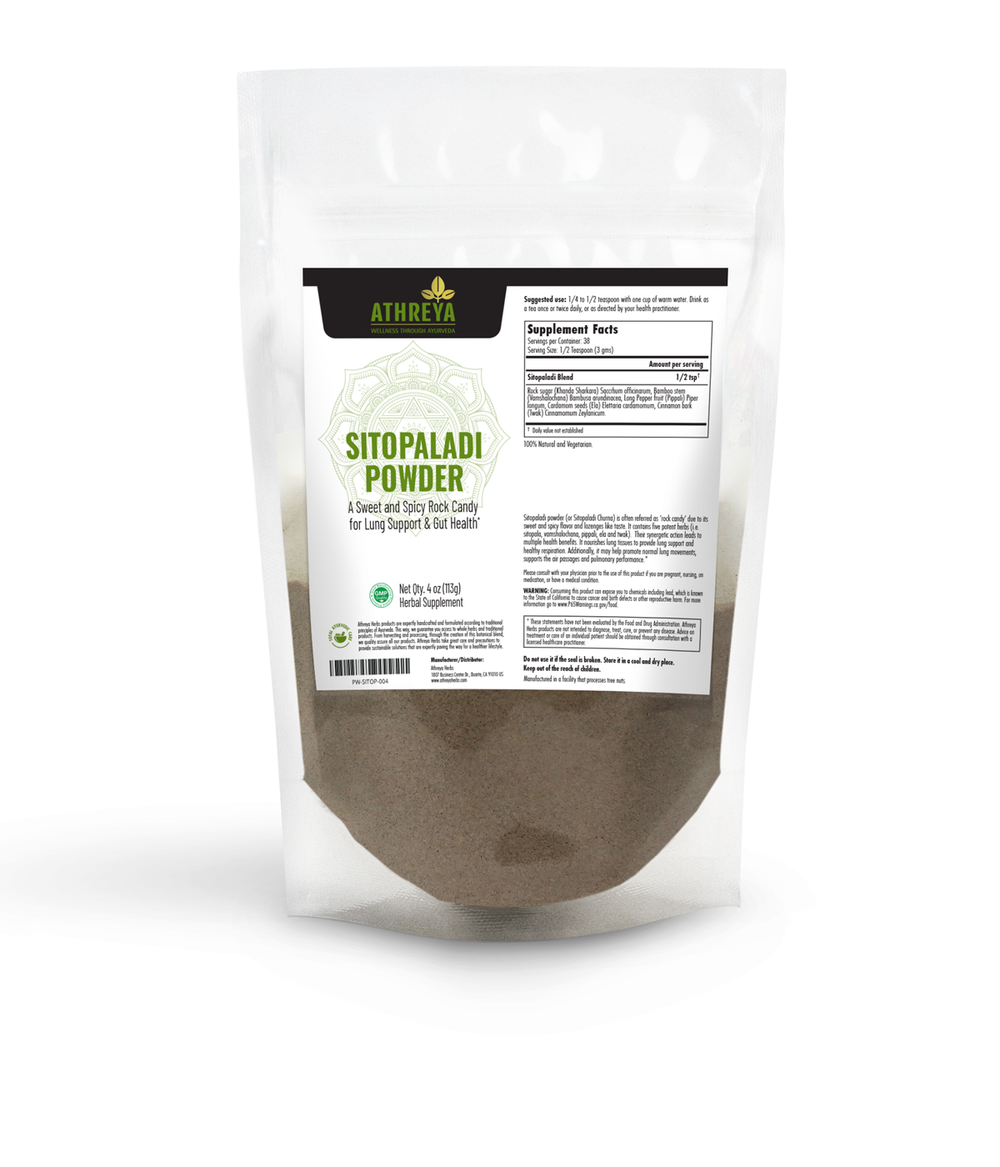
4 of 7 · Sitopaladi Powder
What is Sitopaladi?
The gentle one. Here it is in fifty seconds:
"Sitopaladi has two main ingredients. One is the rock sugar, second one is the bamboo crystal. These two have a wonderful action on the mucous membrane. One replenishes the mucous membrane. Another one absorbs the excess, making it soothe out completely."
The name. Sitopala is rock sugar (sita, white; upala, stone) and adi means and the rest: the formula that begins with rock sugar. Say it see-toh-PAH-lah-dee. Five ingredients in a fixed classical ratio: rock sugar, Vamshalochana (bamboo manna), Pippali, cardamom and cinnamon.
How I take it, from the video: "Sitopaladi powder mixed with honey and liquid. And there you go." Sweet and cooling around a little warmth, it is the one most people can take. Sitopaladi supports lung health and respiratory wellness, helps maintain clear breathing and comfort in the respiratory system, supports digestive comfort, and supports a healthy response to seasonal and environmental stressors.

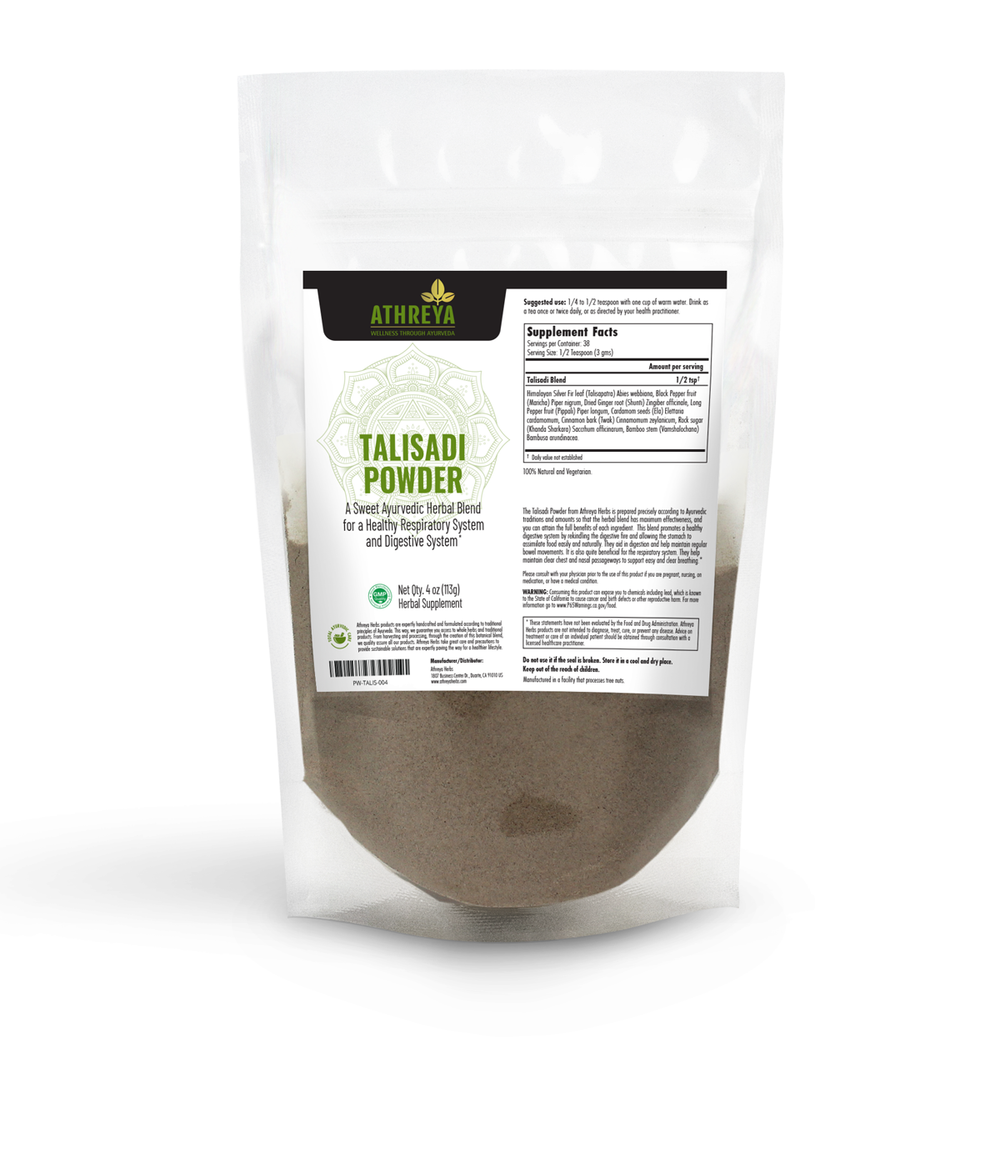
5 of 7 · Talisadi Powder
How is Talisadi different from Sitopaladi?
"Talisadi begins where Sitopaladi begins and then adds talisa leaf and warming peppers. It is the slightly stronger sibling, traditionally chosen when the chest wants a little more warmth. I keep both in the kit and let the day decide."
The name. Talisa is talisapatra, the leaf of the Himalayan silver fir; adi, and the rest: the formula that begins with talisa leaf. Say it tah-lee-SAH-dee. Besides the leaf it carries all three pungents, Pippali, Maricha and Shunthi (dried ginger), over the same rock sugar and bamboo base.
Warming, balancing and respiratory-supporting: Talisadi helps maintain clear airways and ease of breathing, supports comfort in the chest and nasal passages, supports efficient digestion and nutrient assimilation, and supports healthy circulation. On a heavy, damp morning when the chest wants heat, this is the tea. Same cup of warm water, same quarter to half teaspoon, once or twice a day.

The Decoctions
What is a kashayam?
A kashayam (kuh-SHAH-yum) is a water decoction: the herbs are simmered in sixteen parts of water until it reduces to a fraction, so the water carries what the roots and barks hold. It is the oldest form in Ayurveda and the deepest-reaching. Athreya prepares these classically and bottles them ready, so there is nothing to simmer at home: one to two teaspoons with an equal amount of warm water, twice daily after food. I keep two in the shield, one that clears and one that warms.
6 of 7 · Amruthottara Kashayam
What is Amruthottara Kashayam?
The name. Amruta (also Amrita) is the nectar of immortality, and the Sanskrit name for Guduchi; uttara means foremost. The decoction led by Guduchi. Say it um-roo-TOH-tuh-rah kuh-SHAH-yum.
Three herbs only, from the Sahasrayogam, the Kerala compendium of a thousand formulas: Guduchi, Shunthi (dried ginger) and Haritaki. Prepared the classical way, Amruthottara is valued for supporting Pitta balance, metabolic function and overall wellness. It is traditionally used to support internal cooling and balance, it supports internal cleansing pathways and digestive efficiency, and it supports immune health, helping the body maintain resilience during seasonal and environmental changes.
Of the two decoctions this is the light, clearing one. Guduchi is among the herbs Ayurveda names first when it speaks of strength and resilience, and here it is in its oldest form, with ginger to kindle the fire and Haritaki to keep things moving gently. Warm, after food, twice a day.

7 of 7 · Dashamoola Katutraya Kashayam
What is Dashamoola Katutraya Kashayam?
The name. Dasha, ten; moola, root: the ten roots. Katu, pungent; traya, three: the three pungents, dried ginger, black pepper and long pepper. Ten roots with the three pungents, and one leaf, Vasa. Say it duh-shuh-MOO-lah kuh-too-TRY-yah kuh-SHAH-yum.
Dashamoola is the root group I wrote about in Dashamoola Tea: Restoring Strength from the Roots, the five tree roots and the five small roots that work on the deep tissues, principally for Vata. The same ten roots are inside Chyavanaprash. Here they are decocted with the pungents and Vasa, so the formula is warming and opening. "Dasha Mula for 100 years of healthy living." That is how I open the tea video, and the roots are the same.
Dashamoola Katutraya is valued for supporting respiratory wellness, digestion and overall metabolic balance. It is traditionally used to support respiratory health, helping maintain clear airways and comfortable breathing, it supports digestive strength and metabolism, it contributes to joint comfort and mobility, and it supports Vata and Kapha balance, especially during seasonal or environmental changes. Of the two decoctions, this is the warm one.
★★★★★
"worked great for me!"
A verified buyer

The Routine
How do the seven fit into one day?
The jam first thing. The tablets with warm water. A powder as a tea when the throat or chest asks for it. A decoction, warm, after lunch and after dinner. Spread across the day, the seven never crowd each other, and each one does its own job.
| Place | Formula | Form and how I take it | Its job in the shield |
|---|---|---|---|
| 1 · The foundation | Chyavanaprash Lehyam | Herbal jam. 1 to 2 teaspoons before breakfast, warm water or warm milk. | The daily rasayana: vitality, natural defenses, comfortable breathing. |
| 2 · Every day | Healthy Immune Tablets | Tablet. 1 to 2 daily with warm water. | Immune wellness and resilience to everyday environmental stressors. |
| 3 · Every day | Breathe Healthy Tablets | Tablet. 1 to 2 once or twice daily with warm water. | Respiratory support: warmth to the chest, open and clear air passages. |
| 4 · With honey | Sitopaladi Powder | Powder. 1/4 to 1/2 teaspoon in warm water as a tea, once or twice daily; classically with honey. | The gentle one: clear breathing and comfort in the respiratory system. |
| 5 · With honey | Talisadi Powder | Powder. 1/4 to 1/2 teaspoon in warm water as a tea, once or twice daily; classically with honey. | The warmer one: clear airways, comfort in the chest and nasal passages, digestion. |
| 6 · The decoctions | Amruthottara Kashayam | Decoction. 1 to 2 teaspoons with equal warm water, twice daily after food. | The light, clearing one: Pitta balance, internal cleansing pathways, seasonal resilience. |
| 7 · The decoctions | Dashamoola Katutraya Kashayam | Decoction. 1 to 2 teaspoons with equal warm water, twice daily after food. | The warming one: clear airways, digestive strength, Vata and Kapha balance. |
The Immune Shield Collection
Seven formulas, one shield, built before the season turns.
Vaidya Jay's Notes
Questions my community asks.
Can I take Chyavanaprash every day?
Yes, that is how it is meant to be taken. Chyavanaprash is a rasayana, a food more than a formula, and Athreya's suggested use is one to two teaspoons daily before breakfast with warm water or warm milk. I let it dissolve slowly on the tongue. If you take daily medications, ask your practitioner how to space them.
How do I take a kashayam?
A kashayam is a classical water decoction, and Athreya prepares it for you, so there is nothing to simmer. Take one to two teaspoons with an equal amount of warm water, twice daily after food, or as your practitioner recommends. Amruthottara is the lighter, cooling one and Dashamoola Katutraya is the warming one.
What is the difference between Sitopaladi and Talisadi?
They come from the same chapter of the Sharangadhara Samhita and share the same base of rock sugar and bamboo manna with pippali, cardamom and cinnamon. Talisadi adds talisa leaf, black pepper and dried ginger, so it is the warmer of the two. Sitopaladi is the gentle one most people can take; Talisadi is for the heavy, damp mornings when the chest wants more warmth.
How do you say the names?
Chyavanaprash: chyuh-VUN-uh-prahsh. Lehyam: LAY-hyum. Sitopaladi: see-toh-PAH-lah-dee. Talisadi: tah-lee-SAH-dee. Kashayam: kuh-SHAH-yum. Amruthottara: um-roo-TOH-tuh-rah. Dashamoola Katutraya: duh-shuh-MOO-lah kuh-too-TRY-yah. Every letter sounds, and the capitalised syllable is where an English speaker can lean.
When in the day do I take each one?
The jam first thing, before breakfast. The tablets with warm water, once or twice a day. The powders as a tea in warm water, or classically stirred into a little honey, once or twice a day. The decoctions warm, twice a day after food. Spread across the day, the seven never crowd each other.
Can children take these?
Please ask your practitioner first. Children have their own constitutions and their own doses, and the right answer is personal. Keep it safe and simple.
Do I need all seven?
No. Start with the foundation, Chyavanaprash every morning, and add what your body and the season ask for. Each of the seven has one job in the shield, and your practitioner can tell you which belong in your routine.
Why October?
Ayurveda calls the two weeks where one season hands over to the next ritu sandhi, the junction, and the texts regard it as the moment the body is most easily unsettled. October sits on it. Winter is the season for rejuvenation and replenishing, so I build the shield now, before the season turns, and let winter do its work.
Read the full transcripts ▾
Vaidya Jay, in his own words · two YouTube teachings · lightly edited for clarity
This is a traditional Ayurvedic teaching. It is education, not medical advice.
Chyavanaprash, the gift of the sages · YouTube, 5:36
If you are sending off your kids to the school, then Chyavanaprash needs to be in their day-to-day life. If you need to boost your immune system, then Chyavanaprash is what you need. If you want to eat slowly, [...] Chyavanaprash is for you. And if you want to keep your gut healthy, Chyavanaprash is everyday dose for you. Chyavanaprash is the gift of the ancient sages of Ayurveda to the world to keep us strong and immune boosted.
Immune system is so important for keeping our bodies in a place of equilibrium. Immune system constantly senses everything that we are exposed to and tells what is our need and what is not, what is safe for us and what is not. This constant intelligence is done by our immune cells. The immune system is so complex, it's very difficult to understand what it is so difficult to understand the intricacies of the immune system. Rather, it's better to know how to make a immune system that is more synchronized with all its components. And the ancient sages of Ayurveda thought that they can come up with this master formula, that formula which has all the aspects to keep our immune systems pristine and strong. And that formula is nothing but Chyavanaprash.
Chyavanaprash, the main ingredient is the Indian gooseberry which we call as Amalaki. Amalaki is one of the world's richest source of vitamin C in its natural form. That means it's bioavailable and ready to absorb. And this Amalaki fresh juice of this plant and the pulp from the fruit is taken and concocted along with 40 odd herbs that go into this formula. In here are natural jaggery, honey and ghee. They suspend all these active principles and make them available to our gut, to our limb, to our blood, to the muscle, to the fat so that everything can be easily delivered. That was the master plan of these great sages. And Chyavanaprash is curated for last 2500 years to become the number one immune tonic that Ayurveda promotes.
It's not bad to taste Chyavanaprash on a daily basis. I'm going to show you how does the consistency of it and how it tastes. It's an acquired taste but it's worth all that immunity that you need. So yummy. Sweet, sour, pungent, astringent and bitter taste all packed in stimulating every part of my gut. I can feel it in my mouth. My mouth is full of saliva so I can talk. I'm just enjoying it. It's so good. It's so creamy and rich yet has a little bit of rough texture to it and it gives your mouth a complete new stimulation that makes you feel that this is something really powerful.
At Athreya, we use the traditional formula of making Chyavanaprash. When we make Chyavanaprash, there are 50 odd ingredients that go into it and fresh Amalaki fruit has to be taken. The secret of the formula is using the fresh harvested Amalaki fruit. That's when it has its highest potency and its ability to boost our immune function. When we combine it with other decocted herbs which are 10 roots and many other herbs, all of those will work in synergistic fashion to bring the action of Amalaki, the antioxidant, [...] herb to go into every cell of our body. So when we make it is very very important that you create the Chyavanaprash according to these 3000 year old textbook because there is a tradition and in the tradition is the secret of the formula and it will give you the benefits that you are looking for when you take Chyavanaprash with 50 ingredients as we do in Athreya.
Wood fire is what you need to make the Chyavanaprash to get its best properties and that's what the great sages did and that's what we do at Athreya. We have the wood fire burning and there's a big pot of decoction in which all of the ingredients are added and concocted and as this concoction is going on we take a clean cloth and suspend the freshly harvested Amalaki fruit in it along with Haritaki fruits they are suspended and we boil it until the Amalaki becomes soft. We take the bag out and then we take by hand all the fruits apart to take the seed out of it and this pulp is grinded and then roasted with ghee. The pulp is added back to the concoction that was boiling and then we add all the natural jaggery as a sugar and then the honey and everything is mixed together to get this sticky chewy consistency of Chyavanaprash. That's what makes the Chyavanaprash so tasty and yet very potent.
Sitopaladi in fifty seconds · YouTube
Is summer heat making your throat to dry and itch? And is your nasal passages dry? And your sinuses are unsettled? Then you have an issue with your mucous membrane. And Ayurveda selects Sitopaladi as one of the formulas to replenish the mucous membrane and to make the discomfort go away.
Now what is Sitopaladi? Sitopaladi has two main ingredients. One is the rock sugar, second one is the bamboo crystal. These two have a wonderful action on the mucous membrane. One replenishes the mucous membrane. Another one absorbs the excess, making it soothe out completely. The way you can take it is very simple. Sitopaladi powder mixed with honey and liquid. And there you go. At Athreya, we have classically prepared Sitopaladi powder, which is good for your throat, nose, and sinuses.
Continue Exploring
More from the 100 Years Blog.
Athreya, Wellness Through Ayurveda
Founded by Vaidya Jay · Baldwin Park, California
📍 12731 Ramona Blvd, #208, Baldwin Park, CA 91706
📞 +1 323-909-2981 · ✉ info@athreyaherbs.com
🕒 Monday to Friday · 9am to 5pm
Disclaimer
These statements have not been evaluated by the Food and Drug Administration. This article is for educational purposes only and is not intended to diagnose, treat, cure, or prevent any disease. Always consult your physician, qualified healthcare practitioner, or licensed healthcare provider regarding your health, especially if you are pregnant, nursing, have a medical condition, or are taking medications. Individual results may vary.